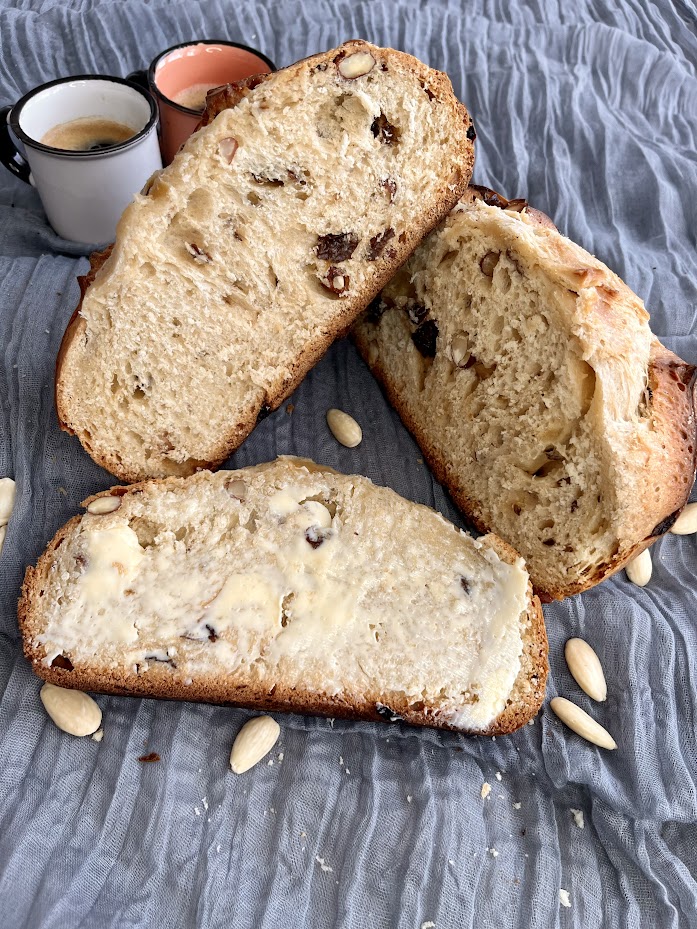

Ingredients
Method
- The Initial Mix: In a mixing bowl, combine the active Lievito Madre, lukewarm milk, flour, all sugars, egg yolks and the whole egg. Mix these ingredients into a compact, cohesive mass. Leave out the cold butter, oil, salt, spices, raisins, and nuts for now. Cover the bowl and let the dough rest for exactly 1 hour.
- Developing the Dough: After the 1-hour rest, add the cold cubed butter, salt, and spices. Knead the dough thoroughly and patiently until the butter is completely incorporated and the dough becomes elastic, pulling away beautifully from the sides of the bowl. 🧈
- Adding the Fillings: Gently fold in the drained raisins and the toasted nuts until they are evenly distributed. Cover and let the dough rise until it has noticeably grown and puffed up.
- Shaping & Banneton Proofing: Turn the dough onto a clean surface and shape it into a tight, smooth round boule. Place it into a round proofing basket (ošatka) and let it rise again until perfectly puffy. This keeps the loaf tall!
- The Bake with Steam: Preheat the oven to 210 °C. Score a cross on the top of the dough. Place the loaf into the oven and bake at 200 °C with heavy steam for the first 10 minutes. To master this critical step, read the complete guide on steam in home baking.
- Releasing Steam & Temp Drops: Release the steam from the oven and lower the temperature to 190 °C without steam for another 10 minutes. Finally, drop the heat down to 170 °C and bake for 20 to 40 minutes. The bread is done when the internal temperature hits 88 °C. (Tip: If the crust is browning too quickly at any point, simply cover it with a piece of aluminum foil.)
- The Glaze: Immediately after taking the hot loaf out of the oven, brush it generously with the melted butter and rum mixture. Let it cool completely on a wire rack before slicing. ✨
Notes
The Chemistry of Sweet Sourdough & Delayed Fat
Baking enriched doughs without commercial yeast requires a strong, active culture. That is exactly why this recipe uses a stiff Italian Lievito Madre. The stiff nature of the starter keeps the dough from becoming overly acidic, resulting in a mild, milky, and perfectly sweet crumb. 🧪✨
Notice the two-stage mixing method in the recipe instructions. Following the golden rules of yeast doughs, cold cubed butter and heavy mix-ins (like soaked raisins and nuts) are added only after the initial dough has rested for an hour.
This crucial resting phase allows the gluten network to build up beautifully without the fat coating the proteins. By delaying the fat, the final bread becomes incredibly light and shreds into soft, cotton-like strands.