Have you ever scaled up a beautiful cake recipe, only to end up with a burnt crust and a raw center? Adjusting ingredient weights is simple, but guessing the new baking time can completely ruin the hard work.
The new baking time converter eliminates the guesswork. Instead of rough estimates, it calculates the exact baking time using the actual physics of thermodynamics and heat transfer.
The Physics of Heat Transfer
Imagine increasing a dough batch from 500g to 750g. That is 50% more dough. If you simply multiply the original 45-minute baking time by 1.5, you will get nearly 68 minutes. The result? A completely dried-out, overbaked disaster.
Heat travels gradually to the center of the dough. In a standard pan, where the dough expands in both width and height, the required baking time increases proportionally to the two-thirds power of the mass ratio.
The baking time converter is built on this exact mathematical law:
If we plug the numbers from the example into the equation, the math looks like this: 45 · 1.52/3. The true required time is approximately 58.96 minutes. The calculator perfectly rounds this to 59 minutes, saving the bake from an extra 9 minutes of burning!
Why Pan Shape Changes Everything
What makes this tool truly smart is that it accounts for pan shape. The vessel used drastically alters how heat penetrates the batter:
- Standard Loaf or Round Pan: The complex formula above applies perfectly because the dough expands in all directions, changing both volume and thickness.
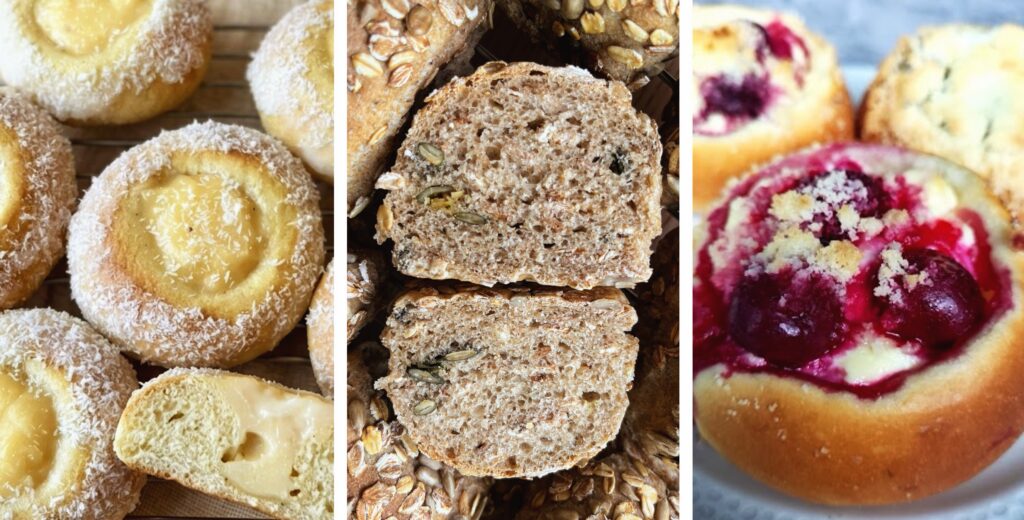
- Sheet Pan (Individual Items): If you double a recipe for individual items like Norwegian Hveteboller and spread them over an extra sheet pan, the thickness of each bun remains exactly the same. The heat has to travel the same distance to the center, meaning the baking time does not change at all.
- Bundt Pan: The central tube acts as a heat conductor from the inside out. Baking is much more efficient and faster compared to a solid round cake of the exact same weight.
The Magic of the “Checking Window”
While mathematically precise, artisan baking is also influenced by real-world variables that a calculator cannot measure. That is why this tool provides a smart Recommended Checking Window (for example, 57–61 minutes) rather than one rigid number. This allows you to account for:
- Pan Material: Dark metals conduct heat much faster than glass or ceramic.
- Oven Specifics: Every home oven has unique temperature fluctuations and varying fan strengths.
- Ingredients: A dense, fudgy chocolate brownie absorbs heat differently than an airy sponge cake. For more on how ingredients affect heat, read about The Chemistry of Cold Fat & The Ultimate Butter-Oil Blend.
Baker’s Tip: When scaling a recipe, always start checking for doneness with a skewer or thermometer at the very beginning of the recommended time window!
Baking Time Converter
Estimate adjusted baking time when scaling recipe batch weight.
Baking Time Converter
Enjoyed this baking deep-dive? Join our Bakeklubb for monthly artisan baking notes and early access to upcoming workshops.