Baking heavily enriched doughs or making homemade custards often leaves behind a bowl full of orphaned egg whites. Instead of tossing them away, transform them into a traditional Czech staple: Bílkový chlebíček (Egg White Cake). ☁️
This cake is incredibly light, fluffy, and serves as the perfect canvas for heavy mix-ins like dark chocolate chunks and roasted peanuts. Because the batter contains no butter in the initial creaming phase and relies entirely on whipped meringue for structure, it melts in the mouth while keeping a beautifully soft crumb.
The Magic of the Remoska
Historically in the Czech Republic, this loaf was frequently baked in a “Remoska”—a brilliant, portable electric baking pan invented in the 1950s. It bakes from the top down and retains moisture perfectly, acting like a miniature closed oven. While this recipe is fully adapted for a standard loaf pan and a conventional oven, the Remoska remains a fascinating piece of European baking history.
Scale It To Your Leftovers
Ready to bake? This recipe uses exactly 210g of egg whites (about 7 eggs). But what if you only have 150g or 300g? Do not let the math ruin your bake!
Simply enter your available egg white weight (treat it as the “Main Ingredient” instead of flour) into the Baking Recipe Scaler to instantly adjust the rest of the ingredients. Once you have your new dough weight, plug it into the Baking Time Converter to find your new exact baking window. Zero math, perfect results!
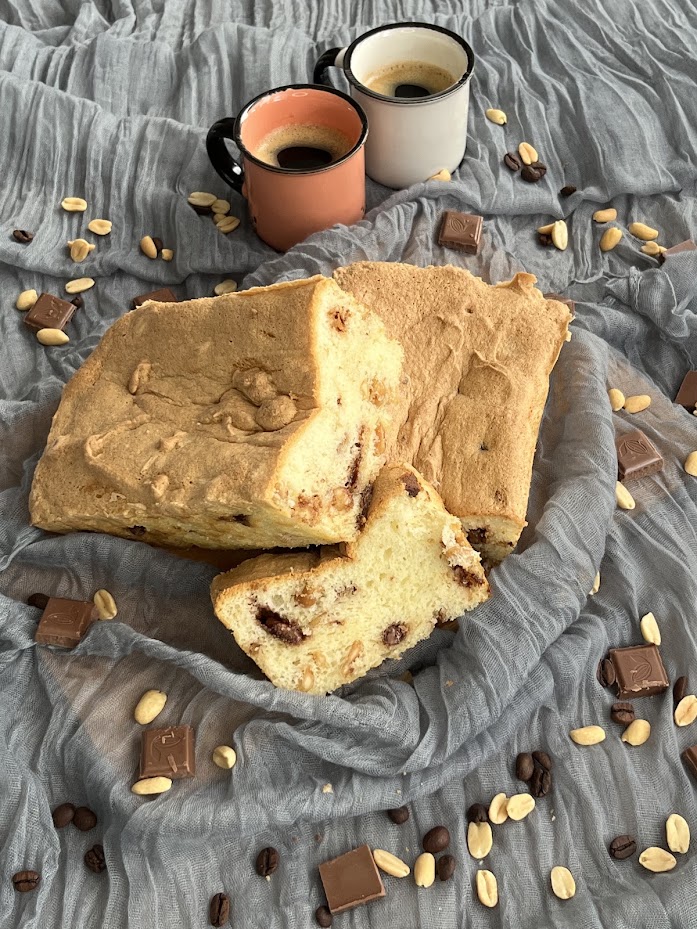

The Egg White Cake
Ingredients
Method
- Prepare the mix-ins: Lightly toast the peanuts in a dry pan over medium heat until golden and fragrant. Let them cool completely, then chop them roughly along with the dark chocolate. Melt the 70g of butter for the batter and set it aside to cool entirely.
- The anti-sinking trick: In a small bowl, toss the chopped chocolate and cooled, roasted peanuts with a teaspoon of all-purpose flour until lightly coated. Set aside.
- The pan lining trick: Preheat the oven to 170°C (340°F) without the fan setting. Lightly grease a standard loaf pan with neutral oil. Cut three strips of parchment paper: two shorter strips for the side walls, and one long strip to cover the bottom and extend over the two shorter edges. The oil acts as a "glue" holding the paper flat, and the long overhang creates handles for easy removal after baking.
- Whip the meringue: In a meticulously clean and grease-free mixing bowl, whip the egg whites until soft peaks form. Gradually add the granulated sugar while continuously whipping until the meringue is glossy and holds stiff peaks. Do not overbeat until dry!
- Fold with a whisk: Using a hand whisk (not a spatula yet!), very gently fold the single egg yolk into the stiff meringue.
- Add the dry ingredients: Sift the flour and baking powder together. Still using the hand whisk, gently fold the dry mixture into the meringue in three batches, being careful not to deflate the trapped air. The whisk cuts through the meringue better than a flat spatula for these fine ingredients.
- Fold with a spatula: Now switch to a silicone spatula. Gently fold in the flour-coated chocolate and roasted peanuts.
- The final fat: Pour the melted, completely cooled butter down the side of the bowl and use the silicone spatula to fold it in swiftly but gently until just combined.
- Bake: Pour the batter into the prepared loaf pan and smooth the top. Bake for 30–35 minutes, or until a wooden skewer inserted into the center comes out clean.
- Cool: Let the loaf cool in the pan for 10 minutes. Then, grab the overlapping parchment paper handles and lift the loaf directly onto a wire rack to cool completely.
Notes
Enjoyed this baking deep-dive? Join our Bakeklubb for monthly artisan baking notes and early access to upcoming workshops.
How long do leftover egg whites last in the fridge?
Freshly separated egg whites can be stored in an airtight container in the refrigerator for up to 4 days. If you cannot bake this egg white loaf within that time frame, simply freeze the whites! They freeze beautifully for up to 3 months. Thaw them overnight in the fridge before whipping.
Can I substitute the roasted peanuts?
Absolutely. While roasted peanuts give this cake a wonderful warmth, they can easily be swapped for equal amounts of roasted hazelnuts, walnuts, or even pecans. Just remember to toast the nuts first and toss them in a little flour to prevent them from sinking to the bottom of the pan.
Why did my egg white cake turn out dense and rubbery?
The fluffiness of this zero-waste cake relies entirely on the air trapped inside the meringue. A dense cake usually happens for two reasons: either the egg whites were over-whipped until dry and chunky (making them impossible to fold smoothly), or the melted butter was too hot when added, which instantly melts and deflates the delicate foam structure. Always let the butter cool completely!
How should I store this leftover egg white cake?
Store the completely cooled loaf in an airtight container at room temperature for up to 3 days. Because this recipe uses oil-rich mix-ins and a solid meringue base, it retains its moisture wonderfully without drying out quickly.