There is something deeply satisfying about making classic English Muffins from scratch. 🍞✨ Forget the dense, dry store-bought versions; these homemade beauties are soft, fluffy, and bursting with those iconic nooks and crannies.
This recipe relies on a traditional Czech preferment (omládek) and the fascinating technique of dry griddle baking.
To understand exactly why this method creates such a unique texture without an oven, explore the detailed guide on The Science of Griddle Baking.

English Muffins
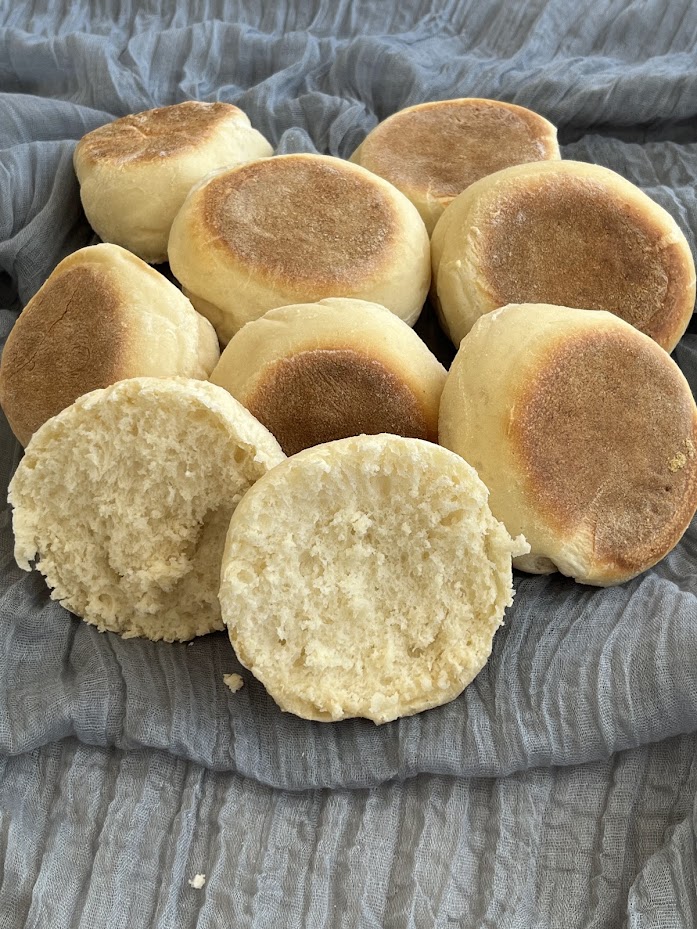
The homemade English Muffins full of nooks and crannies, baked on a dry griddle and naturally leavened with a traditional Czech omládek preferment.
Ingredients
Method
- Prepare the preferment (omládek): Dissolve the fresh yeast in the milk, add the flour, and mix until smooth. Let it rise in a warm place for about 30–45 minutes until noticeably bubbly.
- Mix the main dough: Add the milk, egg, sugar, and flour to the active preferment. Mix well until a cohesive mass forms.
- Develop the dough: Add the salt and cold, cubed butter. Knead patiently until the dough is smooth and elastic. The dough will be intentionally very loose and slack! 🧈
- First rise (Cold Fermentation): Because this dough is so highly hydrated, working with it at room temperature can be tricky. For much easier handling, cover the bowl and place it in the fridge to proof for about 2 to 2.5 hours. (Alternatively, you can skip making the omládek entirely, mix all the ingredients at once, and let the dough cold-proof in the fridge overnight!) ❄️
- Shape the muffins: Turn the chilled dough out onto a work surface lightly dusted with flour. Roll it to a thickness of 1 to 1.5 cm. Cut out circles with a diameter of about 8 cm (this yields approximately 9 muffins).
- Second rise: Place the cut circles on a surface dusted with semolina or flour, cover them, and let them rise again until puffy.
- Bake on the griddle: Heat a dry pan or griddle to 180°C. Bake the muffins on the dry surface for exactly 10 minutes on each side until deeply golden. Let them cool slightly on a wire rack before serving. 🍳
Notes
Working with Slack Dough ❄️
The dough for these muffins is meant to be very loose and sticky—this high hydration is exactly what creates steam and builds those beautiful large air pockets! Chilling the dough solidifies the butter and relaxes the gluten, making cutting the muffins incredibly easy without the need to add excess flour. The Chemistry of Griddle Baking 🧪✨
Cooking these muffins on a dry griddle rather than baking them in an oven relies on direct heat conduction. This intense heat from the bottom creates a thick, toasted crust while rapidly expanding the gases inside the dough. Because the top remains cool initially, the bubbles shoot straight upward, forming the iconic vertical tunnels (nooks and crannies). Using fat on the pan would fry the dough and seal the pores, preventing this beautiful expansion! The Golden Rule: The Fork Split 🍴 A knife smoothly cuts right through the delicate internal structure, smoothing it out and ruining the air pockets built during fermentation. Preserves the texture: A fork gently divides the muffin along its natural air pockets. Maximum crispiness: The torn, uneven surface allows butter and jam to soak deeply into the crumb, while the jagged edges toast up perfectly crispy. How to do it step by step: 1. Take a regular dining fork. 2. Pierce the prongs perpendicularly into the middle of the side of the muffin. 3. Proceed in regular steps around the circumference until going all the way around the middle. 4. Finally, gently pull the muffin apart into two halves with both hands.
Enjoyed this baking deep-dive? Join our Bakeklubb for monthly artisan baking notes and early access to upcoming workshops.